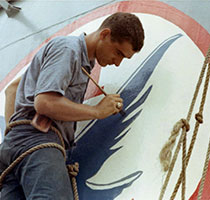
CDR Nicholas Frank, Jr.
Unlocking Luzon
The Drive to Lingayen Gulf
TAYLOR (DD 468) departed Leyte Gulf on 4 January 1945 in the screen for the covering force.
On 5 January 1945, Berkeys convoy sailed through a morning of quietness in the Mindanao Sea — no suiciders, no mines, no submarines. It seemed like the good old pre-kamikaze days when resistance was not expected before arriving at the objective area.
Approaching the objective when passing tiny Apo Island between Negros and Sequijor, at 1509 that afternoon, a TBS message suddenly broke the drowsy silence: “Torpedoes off our starboard bow headed toward formation!” It was from the destroyer NICHOLAS (DD 449) (Commander Robert T.S. Keith) which was part of Admiral Berkey’s leading group.
“Torpedoes sighted dead ahead!” confirmed Commander Nicholas J. Frank, Jr., from the bridge of his destroyer, the TAYLOR (DD 468). He had sighted the bubbling wakes of two torpedoes dead ahead of the NICHOLAS and on the starboard bow of the cruiser PHOENIX (CL 46).
“Torpedoes on coarse south headed for BOISE (CL 47)!” radioed PHOENIX (Captain Jack H. Duncan).
“All ships emergency turn 45 degrees starboard,” blared the orders from Admiral Berkey.
On BOISE (CL 47) the helmsman spun the wheel hard to starboard as Captain Downes ordered flank speed. The torpedoes streaked by close as frolicking porpoises, surfaced in the middle of the convoy to float for a minute as if frustrated, and then sank.
If the torpedoes had found their mark it would have been the second time in as many operations that the enemy had hit the one ship carrying the top personnel. When NASHVILLE (CL 43) had been hit by a Kamikaze en route to Mindoro, it will be recalled, she had been carrying Admiral Struble and General Dunckel. During the engagement, General Douglas MacArthur and staff embarked in BOISE. It was too much of a coincidence to be wholly luck.
The NICHOLAS and TAYLOR were ordered to get the sub. “Submarine surfacing dead astern!” shouted two of TAYLOR’s lookouts, Wallace Walter Knox, GM 2/c, and George Bolin Badget, Jr., S 2/ c, almost in unison.
“Emergency flank speed. Right full rudder”. The destroyer’s nose slowly began to rise out of the water as it turned toward the broaching submarine.
At this point a torpedo plane that was on antisubmarine patrol from one of the escort carriers dived on the submarine, a little less than a mile from TAYLOR. Commander Frank, radioing to the plane to stand clear, charged down on the sub. It was now seen to be one of the midgets, about 60 feet long and 6 feet wide, and evidently hurt, for its bow angled 30 degrees out of the water.
The TAYLOR sliced into the greenish-black hull amidships. It split like a sardine can under a hatchet blow and instantly sank.