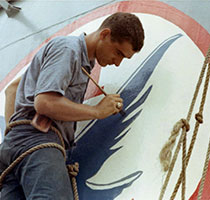
Operation Dominic I – 1962
Gary Smith
Gary Smith of Lebanon, OR was in the Navy in 1962, serving on the USS Taylor when the United States began testing nuclear weapons on Christmas Island.
He remembers looking up after the blast and being “awestruck, really, by the power, the enormity of the situation.”
But in the decades to come, he couldn’t get answers about exactly what had happened on the island, and what he might have been exposed to.
For a long time, he said, no one would even officially recognize the tests took place.
Years later, Smith heard about an organization of the veterans supporting soldiers who were exposed to radiation through their service. But it wasn’t until Wednesday – the day he met Fred Schafer of Lebanon at the traveling Vietnam memorial wall in Albany and saw the “Atomic Veterans” ball cap Schafer was wearing – that he learned his hometown had a chapter he could join.
That chance encounter brought Smith to the American Legion in Lebanon on Thursday to join the National Association Of Atomic Veterans and mark July 16, Atomic Veterans Day.
“l think it’s outstanding,” said Smith, who said he plans to contact the Veterans Administration to become a part of the Ionized Radiation Registry. “l think anyone who participates in registering will help all atomic veterans.”
July 16, 1945 was, the day the first atomic bomb was tested, an experiment in Los Alamos known as the Trinity Test.
But in the early days of the nuclear testing, solders were sworn to secrecy about their service, an oath requirement that wasn’t rescinded until 1996. According to the NAAV, some 195,000 of those atomic veterans are still living today, many of whom do not know they are now free to tell their stories.
Frank Farmer of Lebanon, area commander for the Oregon chapter, remembers those days. He still has tinnitus from the blasts he witnessed on Christmas Island from his ship, the USS Hooper Island.
“l couldn’t even tell my doctor about this until 1996,” he said. “l couldn’t tell my wife about it. Or if you did, and they found out about it, they could get you for treason. That’s what we were told.”
The National Association Of Atomic Veterans formed in 1979 as a way for soldiers who had been exposed to radiation to speak about their health and the way it may have been compromised by their service.
At the Lebanon gathering, Jim Willis, director of the Oregon Department of Veterans Affairs, read a statement by Gov. Ted Kulongoski proclaiming the day “Oregon Atomic Veterans Day.” Willis is himself an atomic veteran, Schafer said, having performed some of his military service in the Midwest guarding missile silos.
Rep. Sherrie Sprenger, R-Scio, also spoke Thursday, thanking the veterans for their service and their courage in doing their duty.
According to the NAAV site, atomic veterans primarily are members of the United States Armed Forces who participated in nuclear weapons tests from 1945 to 1962, who had “post test” duties such as decontaminating field equipment, or who served or were held prisoner in Hiroshima and Nagasaki soon after bombs were detonated there.
The association also recognize veterans were exposed to radiation from tests after 1962 or whose duties involve regular exposure, such as power technicians aboard nuclear-powered aircraft carriers and submarines, soldiers involved in depleted uranium munitions during Gulf War, or soldiers who work with the assembly, storage or deployment of nuclear weapons.
Schafer, an Oregon atomic veteran and group organizer, told approximately 35 people at Thursday’s meeting the NAAV is trying to help its veterans speak up.
He urged veterans present to contact the VA and join the radiation register. Health care is available, he said, as are death benefits.
“It’s available. Use it,” Schafer said. “Even if your health is good, get in. Your health may not always be good. Get in the computer so when you need it, it’s there.”