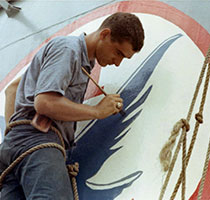
Hugo seaman witnessed first U.S. H-bomb testing
Interview with Dale Lorey
By Michelle Miron I Posted: Thursday, November 8, 2012
HUGO — Dale Lorey takes medication every day to control a blood condition similar to leukemia.
Another truth: several Navy seamen who also witnessed the U.S.’ first hydrogen bomb testing in 1962 are also battling or have died of cancer.
Lorey may have suspicions about whether those facts are related, but that doesn’t affect his pride in having served in the Navy from 1960 to 1964.
“I like to say I was a guinea pig for the last nuclear blast the U.S. ever set off in the biosphere, at Johnston Island in the South Pacific,” he said. “They blew it up to build another one. That’s how I see it.”
Lorey, 69, grew up in Detroit, Mich. one of nine kids. His surgical nurse father and several uncles served in WW II.
He enlisted at age 17 before finishing high school, a path that was more common back then.
“My mom said I wasn’t going,” he remembered. “My dad said ‘Give me that,’ and signed for me.”
After completing basic training in San Diego he was assigned to the supply crew of the USS Taylor, a WW II-era destroyer escort headquartered at Pearl Harbor with a crew of 200 men.
In July of 1962 his crew was ordered to report to deck one evening at 11:30 p.m. for a test. The soldiers were told little, but provided goggles and instructed to use their arms to shield their eyes against what would be a major blast. The experience was to be top secret and classified.
“Everybody was apprehensive,” Lorey remembered. “But when you’re in the ocean as far out as anybody can see, it doesn’t really do you any good to be scared. And when you’re young you’re infallible — nothing can hurt you.”
He said the ensuing silent explosion of a hydrogen bomb 200 miles in the air and 100 miles away created the brightest light he had ever seen — so intense he could see right through his skin to the bones and blood vessels beneath.
“I call it a biggest x-ray anybody ever had,” he noted. “You could literally see right through your arms. And you could see water splashing off the side of the ship. We stood looking for hours at this nonsense.”
For hours afterward the ensuing cloud was a “blood red” color. The crew was in awe, he said, but finally calmed down and went to bed. In the morning several seamen including Lorey were ordered to scrub the decks with seawater where Geiger counters were ticking to reveal radioactive “hot spots.”
Lorey believes now the test was conducted as a warning to the Soviets, who had tested their own bomb earlier.
A few months later he was part of another intense situation when the ship was stationed in the Bering Sea. Without being told why, his crew was put on 24-7 duty at “locked and loaded” guns on board. He realizes now the crew was likely on alert to strike during the Cuban Missile Crisis in case anything went amiss.
“We really were not aware of what was going on in Cuba until we were back in Pearl Harbor,” he noted. “But the U.S. had blown up the bomb, (Cuban) planes were flying, our planes were flying and their subs and our subs were under us. If anybody would have pulled the trigger anywhere in the world right then … I would have said everything would be annihilated.”
In 1963 he was re-stationed on the John S. McCain bound for Okinawa, Japan. He left the service in 1964 as a third-class petty officer.
Afterward he began a series of jobs that culminated in union work, tuckpointing for the bricklaying industry. He retired from the Roseville-based Building Restoration Corp. in 2007 and has lived in Hugo for 10 years.
He was married twice and had three children — Kristi, Christopher and Summer — before marrying his wife Rita 17 years ago.
Nine years ago Lorey noticed he had very little energy and was experiencing severe bruising on his legs.
“The backs of my calves looked like someone had beaten them with a bat,” he remembered. “I was always active – not big, but strong. And my butt was dragging.”
Doctors were baffled at first and never did determine a cause, but soon diagnosed him with a rare condition called essential thrombocytosis that causes blood platelets to turn malignant and multiply rapidly. He was prescribed a new medication called Agreline that made him very nauseous, dizzy and tired at first; since his body has adjusted, side effects are few, though he still can’t drive.
Medicare pays for much of the medication’s $900 monthly cost. But Lorey recently filed a claim with the Veterans’ Administration he hopes will lead to better coverage.
Does he think H-bomb radiation caused his illness?
“Who knows?” he said. “But everything we did there is still top secret to this day.” In fact, he said, correspondence he’s received from the government since then still contains encrypted references.
He’s also emailed several shipmates who have cancer and heard of others who have died of forms of the disease.
He scoffs when asked whether he’s concerned about revealing details in The Citizen.
“I’m 70 frickin’ years old,” he said. “They can come and arrest me.”
That being said, he looks back on his time in the Navy with pride and warmth. These days, he’s an active member of the Hugo American Legion, where he’s in the Honor Guard and plays the bugle at ceremonies.
“I have nothing but positive feelings,” he said of his service. “You go in there as a young man or kid … and become a man.”
His advice for would-be enlistees?
“Go for it. Don’t be afraid. Join the military and fight for your country and represent the U.S.”
Michelle Miron is editor of The Lowdown and sports editor for all Press Publications newspapers.